
 An interview with Adam Woods, CNBC-quoted hedge fund manager.
Jim: Thanks for joining us, Adam. Before we talk about today’s topic, can I get your take on the latest development on what The Federal Reserve said this week. Firstly, for our novices reading, what’s all this talk of ‘tapering or not tapering’ been about?
Adam: Since the financial crisis the Fed has engaged in three rounds of QE- or printing money- to stimulate the economy. Some argue that the only reason why the stock market has risen since 2008 is because of easy money sloshing around the world from global central banks. After QE phase 1 ended the S&P 500 fell 17%. So Bernanke announced QE 2. When that ended the S&P 500 plunged 21%. So then he announced QE 3 in Sep 2012. The stock market didn’t react as strongly as he intended. Initially QE 3 was $40B a month, then when he realized the market was not reacting well he doubled up and said the Fed will now buy another $45B/month for a total of $85B which has been going on since Dec 2012. The stock market soared on the news and we are now at new all time highs! In May of this year Bernanke (the Fed chairman) hinted that the Fed may taper QE (slow down the monthly purchases) and the stock market immediately fell -7.5%. Then in late June he did a 180 and said easy money policies were here to stay and the stock market took off again. As I tell the story it seems like a Hollywood fictional plot but it is all real! All the big banks expected the Fed to taper by 5-15B yesterday to bring the monthly purchases down to 70-75B from 85. When he Fed didn’t do that this week the market ripped higher and yet again hit another record high.
Jim: So, the party goes on. The Fed has painted itself into a corner it seems with “QE4-ever”. The money-printing must end at some point, one way or another though? How will this end if so?
Adam: The Fed has a dual mandate to protect unemployment and inflation but so far deflation has been more of a concern than inflation. That’s why the Fed has managed to print money without any near term consequences. But one day that will change, and the big money knows that. Just like a game of musical chairs, as long as the music is on everyone is having fun (stocks are going up). Eventually the music will stop and I only hope they are able to exit QE gracefully. If not, the hyper-inflation fears may be realized, which is the logical consequence of printing money.
Jim: It’s rumored that the new Fed chairman in 2014 will be Janet Yellen. Do you think she’ll do more of the same or could this be a big change?
Adam: Anything is possible but from what I gather she is in favor of more QE, not less, so one should expect this easy money scenario to last for a while longer. Many insiders believe that the Fed’s decision yesterday was an indirect way of Bernanke passing the power to Yellen. Almost as if she is the one calling the shots right now, not Bernanke.
Jim: Ok, great. And we know it’s not wise to stand in the way of a speeding train when it comes to markets! Now let’s move on to today’s topic. You graciously sent this chart along for our readers, and it shows how much you’d have to gain back after encountering losses if you don’t set a stop loss:
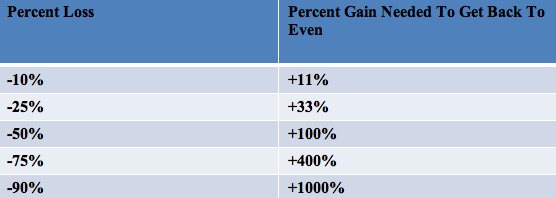
Adam: My pleasure- one of the most important concepts investors (large and small) need to know is the importance of limiting losses. Earlier this week, we just marked the 5 year anniversary of Lehman brothers (which sparked the financial crisis). The only reason why they failed was because they did not respect risk, even though they were a billion dollar firm, the one thing that brought them down and lead to their demise was their inability to respect risk. So I strongly urge any investor to understand and respect risk.
Take a look at that table and you’ll see for yourself, it is MUCH easier to recover from a small loss than a large loss. Here is the kicker: The market cannot take a penny away from you that you won’t let it. You are not forced to hold on to a losing stock, you can sell anything at anytime, and you are free to buy it back.
Jim: So we’re not talking about panicking ourselves out of trading completely, we’re just PLANNING on the fact that we won’t get it right all the time- we have to ride our winners and drop our losers at predetermined levels and come out on top overall. Don’t be scared off by a loss, just walk away and don’t get emotional. And don’t cut winners, ride them.
Adam: Exactly. But most people do the exact opposite on wall st. It’s just like driving… at time you will encounter traffic and it is not fun. But it is part of the process.
Jim: And many readers ask at what level they should set a stop loss. Some people say an arbitrary 25% below the entry price, but I know you think differently.
Adam: People look at an entry point and say I’m going to exit if the stock falls X%…the problem with that is that you do not know how that is going to affect your portfolio. So I like to use a stop loss of 3-5% or 7-8% max. But more importantly, I don’t want to risk more than 1-2% of my overall portfolio if I’m wrong, meaning I will adjust my position size (# of shares I buy) to make sure I do not lose more than 1-2% of my portfolio if I’m wrong. So If I have a 100k portfolio I don’t want to lose more than 1k per idea. Remember you can control your downside, but not the upside. There is no way to know how high a stock will go. All you can do is control your downside and let your winners take care of themselves.
Jim: Yes, great advice. The thinking being that you’ll either be proven right or wrong very quickly, and if wrong, may as well get out sooner rather than later. But I know this is because you’re (wisely) using the chart. The Fed, stop losses, and position sizing. All great advice. Thanks so much, Adam.
Adam: Pleasure.


